Upon the velvet of the red carpet, in the glow of lamps almost as bright as the spring sun, begins one of those charming spectacles that draws the viewer into the action, where the audience plays along with the actors. It is truly difficult to discern what is more captivating at a fashion show: the ensembles, as creations of sartorial art; the living mannequin, presenting the garments; or the rows of ladies for whom the models are presented. What a pity that, until now, the dramatic action of a theatrical play has never been set amidst a fashion revue — for it is an excellent ground for the birth of conflict, for revealing its progression, and ultimately, for its finale. I know not why these feminine gatherings — these most feminine of feminine conferences — evoke a series of thoughts aspiring to "profundity". Nevertheless, the reporting pencil meticulously records the description of each model.
What is Most Striking in This Year's Fashion?
A lack of template, a lack of canons, a lack of dogma. Beyond the fact that every second model represents a different style, what is important is this fondness for combining colours, even to the point of variegation (in the best sense of the word), this distinct tendency towards non-repetition, even at the cost of lacking harmony. Not only is each model different, but each can be worn in several ways, skirts and jackets changed at will, so long as, at all costs, one always looks different. The charm of novelty! The price — of looking different — so as to intrigue, to captivate, to be an Amazon one moment, and a demure shepherdess the next; a vamp in the evening, a doll in the afternoon — and in the morning, necessarily, a sportswoman or a "working woman". The guiding idea of our fashion — self-multiplication through a change of ensemble — is more evident this year than ever before, in all creations. Theoretical discourses, strangely enough, arise in the world of dresses post factum; they are created by the life of the atelier; conclusions, so consistent with the demands of the moment, only then emerge when they are embodied in fabric. So, formerly it was: "youth at all costs" — today it is — "different at all costs".
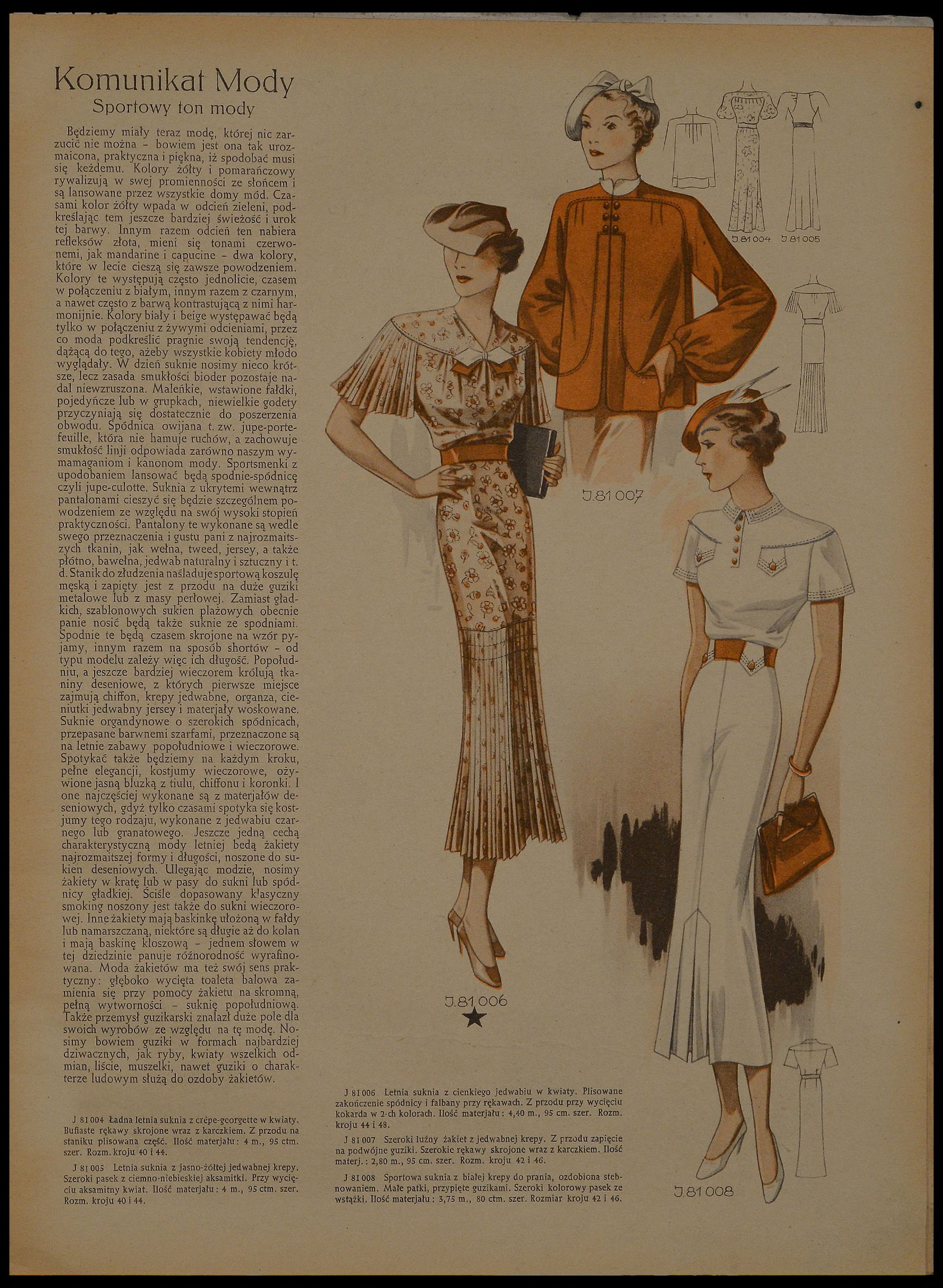
Morning — The Sportswoman
Into the grand hotel hall, where the revue is currently taking place, enter one after another, athletic young women. They wear: beige redingotes, fastened with two rows of large, diagonally, soldier-like buttons — these buttons, and a slightly nipped-in waist, are the most characteristic features of the spring coat. There were no fur-trimmed coats — at the prohibitive price of fox furs, why should one be surprised? — Coats in grey, beige, and most frequently, navy blue.
One must mention the houndstooth coat, black and white with a black velvet collar, and a silk sports coat, also in houndstooth — this silk coat for morning wear — is a novelty! Also new are this year's fashionable colours: little black, even less green (yes, indeed) and bronze. Navy blue, grey, beige, pink (bois de rose), and light blue — such is the order of fashionable colours this season.
Speaking of novelties, one must also mention coats with short sleeves, as well as suits with sleeves ending above the elbow. Let us also not forget short coats, much shorter than 3/4 length, worn in a contrasting colour to the skirt (a grey coat — a navy blue skirt). A man's felt hat, necessarily with a colourful ribbon or a defiantly protruding feather, also brightly hued — completes the charming ensemble. With short sleeves, when wearing an outer garment, woollen gloves, coordinated with the dress or skirt, are fashionable.
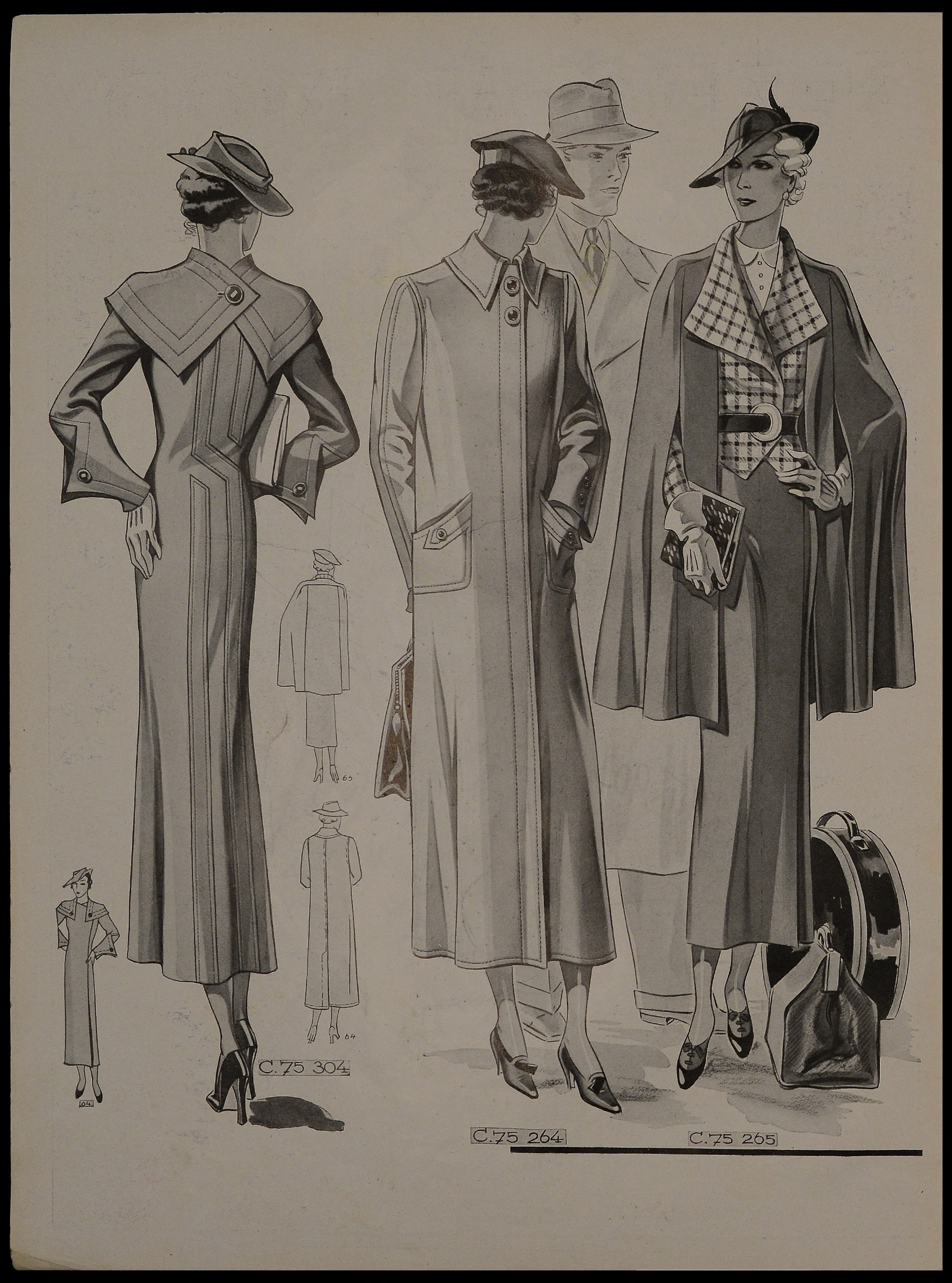
Chapter — Suits
This seems to border on infinity. It is simply difficult to enumerate the variety of combinations in this domain: English smoking suits in a single colour are the least eagerly presented. Instead, woollen dresses with little jackets — short like boleros, longer ones with belts, and finally, loose ones, with pleats on the back like blazers or jackets with wide, often pleated, entirely Chinese sleeves — are shown in every conceivable combination.
A French black smoking jacket — exquisite — has a jacket cut like a tailcoat with a peplum; a light blue dress is appliquéd with pink wool, complemented by a light rose, long, Chinese, loose jacket; a dress with a jacket in light lilac; a navy blue skirt, a pink jacket, a white blouse. Who could possibly enumerate it all?
Most striking is the frequent appearance of the dark pleated skirt, which ought to become the foundation of every woman's wardrobe. How much fantasy can one develop around it? A pink, blue, or lilac jacket (nothing is too flamboyant today) for the morning, while an exquisitely painted satin smoking jacket with Chinese motifs is perfect for a summer afternoon. There were several white smoking jackets, painted in the Chinese style, in the revue.
Wool for This Year's Dresses and Suits
It resembles velvet — it is a special type of velour wool, which constitutes one of the most positive aspects of this year's weaving art. One must also mention wool interwoven with cotton thread, simply linen, and on one jacket — which is very effective.
Summarizing the impressions from the fashionable "Lady's Morning": risky colour combinations in the ensemble, pleating, the favouring of light blue and pink, — influences of Chinese style — these are the most important observations we can note.
Afternoon
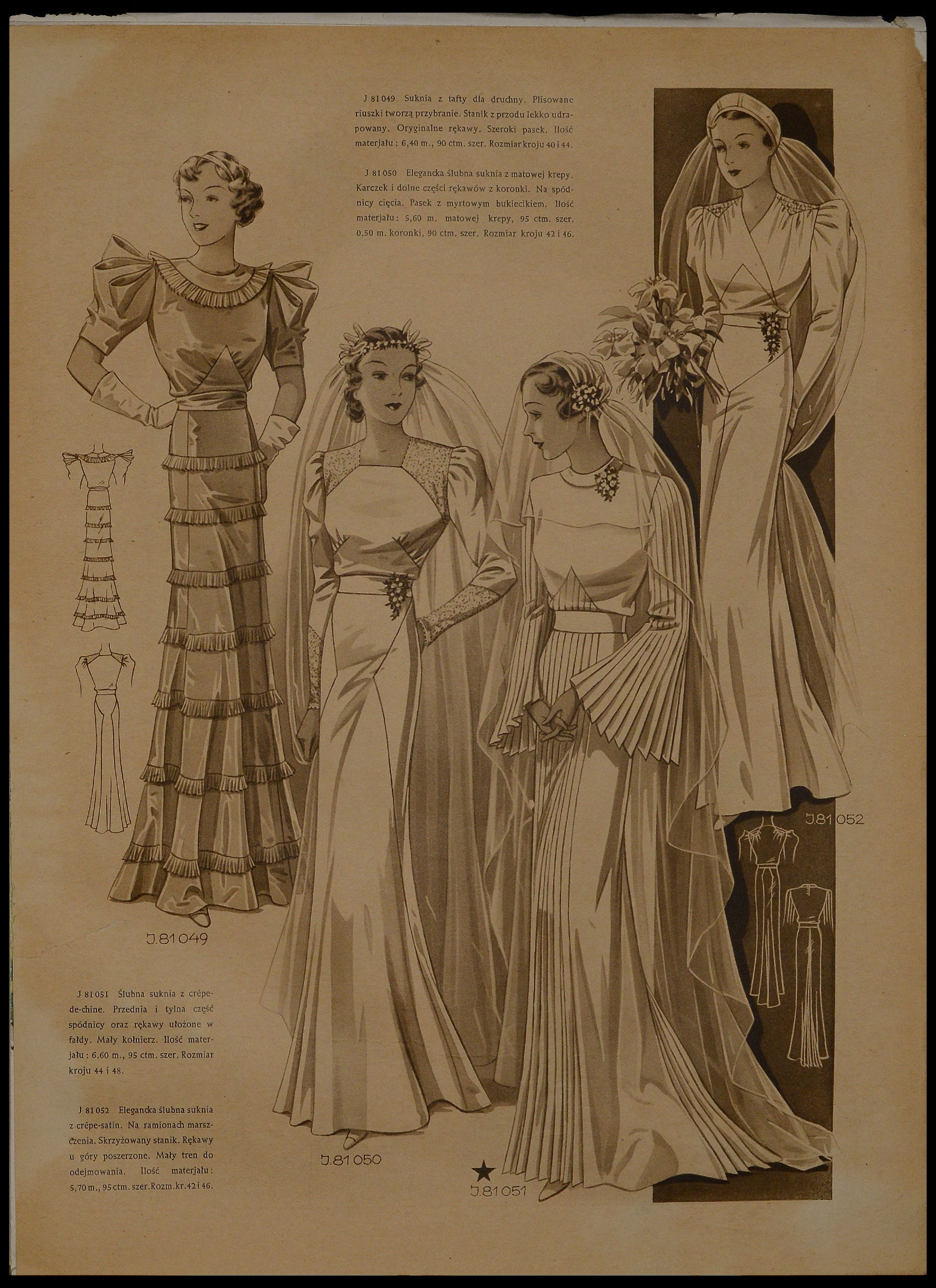
The lady appears to us, as usual in summer, in the splendour of imprimée fabrics. A dark background, a small, whimsical, light motif — this is what dominates the fabrics. Among the multitude of patterns, bows, letters, musical notes, butterflies and fish, and Chinese lanterns have remained in our memory. Most often, the fabric background is black; a loose, patterned jacket accompanies a plain dress.
Capes are becoming fewer — the last remnants still wander through the collections. A black skirt with white polka dots, a white jacket with black polka dots, a blue dress with various types of lozenges, an ensemble consisting of a polka-dot skirt and a checked jacket — all this indicates that the principle of multicolour, of a lack of uniform entirety, repeats itself from morning till evening.
Dresses are readily adorned with piqué for morning and afternoon — floral embellishments, instead of a collar, are also favoured. Ruffles, flounces, a touch of lace, new fabrics — silk combined with wool — and all this in harmony with exquisite hats — small or large — most often with a flower, feather, or veil — these are the superficial impressions from the revue of afternoon attire.
One must also mention dresses with long, Cossack-style gathered sleeves — kazaki — cinched with a Scottish sash, as with the blue dress, or an ornamental belt; and add news of a lovely jacket made of black sznelka — to almost find oneself... in the midst of the description of afternoon fashion.
And Yet, Evening Still Awaits Us
That charming summer evening, when one must obligatorily look "phenomenal", and when such phenomenal beauty is so easily achieved beneath the clear sapphire of the sky. Patterned dresses, with Spanish and Gypsy motifs — also a light motif on a dark background — will inaugurate the green carnival.
Tulle capes, in which one can gracefully drape oneself, yet which offer no warmth; flowing dresses, cut as always; taffeta, stylish creations; taffeta coats with enormous sleeves and airy chiffons — conclude the chapter on this most chaotic, most uncontainable summer fashion of 1936.
Summer Furs
The most popular furrier presented a new collection of summer furs. Ermines were dazzling. Soft, light, already destined in the forest for their purpose — the lustrous ermine pelts have this year foregone their traditional, regal white and gleam on summer coats with a light bronze fur, whose charm is enhanced by the intricate arrangement of these pelts into narrow stripes.
Long coats, cinched at the waist, with generously puffed sleeves at the shoulders; three-quarter length coats; and the latest item, the bolero, replacing the fading capelet — found their perhaps most perfect expression in bronze ermine. There were fewer fox furs — the few wraps consisted of intricately arranged and complexly cut animal skins, also forming boleros.
Bronze and grey broadtail — this fur is no less precious and no less beautiful than a jewel. Broadtail coats indicated that, as a summer fur, they would constitute a perfect complement to a woman's attire.
The photographs for our illustrations were kindly provided to us by the press office of R.K.O. — Radio Films.